
“Retinol peptide” is not a strict standalone scientific molecule classification. In most laboratory, cosmetic chemistry, and formulation contexts, the term refers to a combined system containing retinoids such as retinol together with signaling péptidos or peptide-based delivery technologies. These systems are studied for formulation stability, molecular signaling interactions, controlled release behavior, and biomimetic research applications.
LO ÚLTIMO LISTA DE PRODUCTOS Y PRECIOS
1. Does “Retinol Peptide” Actually Exist?
From a biochemical perspective, the phrase “retinol peptide” can be misleading because it sounds like a single peptide molecule.
Scientifically, that is usually not the case.
In most research and formulation environments, “retinol peptide” refers to:
- a formulation containing retinol + peptides
- peptide-assisted retinoid delivery systems
- biomimetic cosmetic research systems
- retinoid stabilization technologies involving peptides
So the term is:
- commercially common
but: - chemically broad and technically non-specific.
2. Why People Search “Retinol Peptide”
When researchers, formulators, or ingredient buyers search:
- “what is retinol peptide”
- “retinol peptide serum”
- “where to buy retinol peptide”
they are usually trying to understand several deeper questions:
- Is this a real molecule or just marketing terminology?
- Why are peptides combined with retinol?
- What happens molecularly inside the formulation?
- Does peptide technology improve retinol stability?
- Which systems are scientifically meaningful?
The underlying interest is often less about the name itself and more about:
how retinoid systems and peptide signaling technologies interact inside advanced formulations.
3. What Is Retinol?
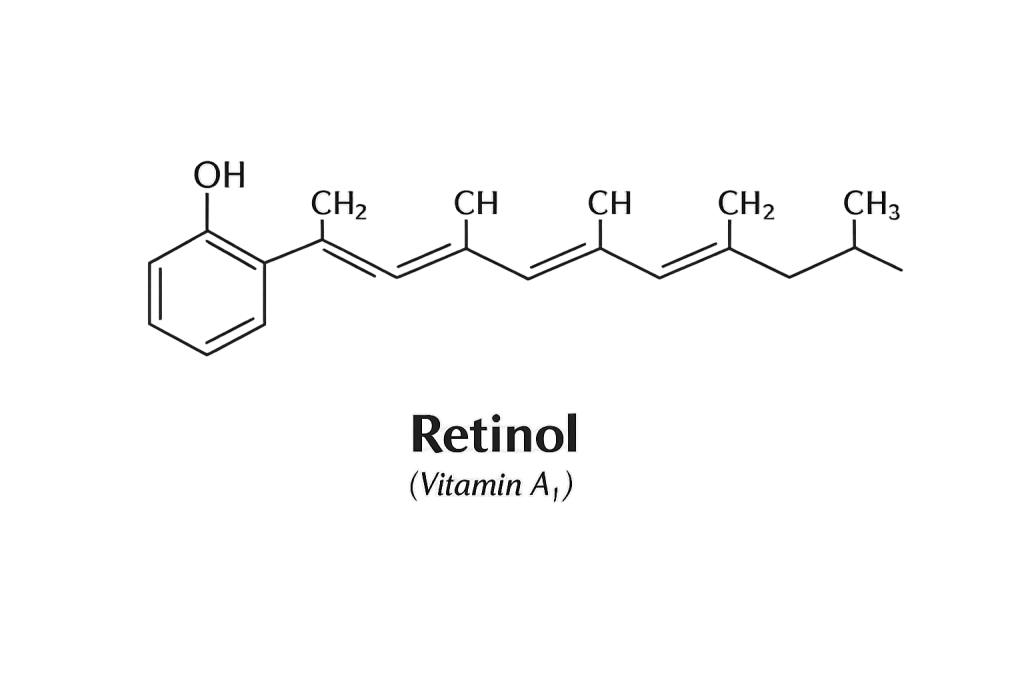
Retinol
Retinol is a vitamin A derivative belonging to the retinoid family.
It is widely studied in:
- cellular differentiation research
- keratinocyte biology
- oxidative signaling pathways
- epithelial turnover models
Molecular Mechanism
Retinol itself is not the final active signaling compound.
Inside biological systems, retinol undergoes conversion steps:
Retinol → Retinal → Retinoic Acid
Retinoic acid then interacts with:
- retinoic acid receptors (RARs)
- retinoid X receptors (RXRs)
These nuclear receptors regulate gene expression pathways. Retinol→Retinal→Retinoic Acid\text{Retinol} \rightarrow \text{Retinal} \rightarrow \text{Retinoic Acid}
Analogía simple
Retinol behaves somewhat like:
- a software update package
It does not directly “build” structures itself.
Instead, it changes how cellular systems interpret and execute biological instructions.
4. What Are Peptides in Formulation Science?
Péptidos
Peptides are short chains of amino acids connected through peptide bonds.
In cosmetic and biochemical research, peptides are commonly studied for:
- comportamiento de señalización
- carrier functions
- molecular communication
- structural mimicry
Common Functional Categories
Signal peptides
Studied for communication pathway interactions.
Carrier peptides
Used in transport-related research systems.
Enzyme-modulating peptides
Investigated for pathway regulation mechanisms.
Analogía simple
Peptides function like:
- molecular text messages
They help biological systems exchange instructions and coordinate responses.
5. What “Retinol Peptide” Usually Means
Most products or research systems described as “retinol peptide” are actually:
multi-component retinoid–peptide formulations
rather than:
one single peptide molecule.
These systems may include:
- retinol
- encapsulated retinoids
- signal peptides
- copper peptides
- biomimetic peptide complexes
6. Why Retinol and Peptides Are Combined
From a formulation chemistry perspective, retinol and peptides complement different mechanisms.
Retinol
Primarily associated with:
- cellular turnover signaling
- differentiation pathways
- retinoid receptor activation
Péptidos
Primarily associated with:
- communication signaling
- transport support
- formulation interaction systems
Combined Formulation Logic
Retinol is highly active but chemically unstable.
Peptides may contribute to:
- formulation support
- biomimetic signaling environments
- controlled delivery systems
- stabilization strategies
Analogía
Retinol acts like:
- a renovation crew rebuilding a structure.
Peptides act like:
- communication coordinators helping organize the process.
7. Why Retinol Formulations Are Difficult to Manufacture
From an industrial research perspective, retinol is notoriously unstable.
It is highly sensitive to:
- oxygen
- ultraviolet light
- calor
- oxidación
Peptides also present stability challenges because peptide bonds may hydrolyze under improper conditions.
Manufacturing Challenges
Advanced formulation systems must carefully manage:
- pH compatibility
- emulsification systems
- oxygen exposure
- encapsulation efficiency
- peptide integrity
- retinoid degradation
Industrial Formulation Technologies
Modern research systems commonly use:
- liposomal encapsulation
- microencapsulation
- airless packaging systems
- nitrogen-protected filling
- low-temperature processing
8. Retinol–Peptide Hybrid Technologies
Some advanced systems investigate:
- peptide-linked delivery systems
- retinoid carrier complexes
- encapsulated peptide-retinoid technologies
These approaches are studied for:
- controlled release behavior
- reduced oxidation
- improved molecular stability
- enhanced dispersion consistency
9. What Buyers Should Understand Before Purchasing
Most experienced buyers evaluate several factors beyond marketing claims.
A. Retinoid Stability
A high retinol percentage means little if:
- oxidation control is poor.
B. Peptide Identity
Many formulations use vague terms like:
- “peptide complex”
without identifying:
- peptide sequence
- peptide concentration
- molecular role
C. Packaging Technology
High-quality systems usually prioritize:
- airless packaging
- UV protection
- low oxygen exposure
because retinol rapidly degrades under poor storage conditions.
10. Research Applications of Retinol–Peptide Systems
These systems are commonly investigated in:
- formulation stability studies
- biomimetic signaling research
- oxidative stress modeling
- cellular communication analysis
- controlled release technology development
11. Where to Buy Retinol Peptide Products
For laboratory research inquiries regarding retinol–peptide systems and related biochemical materials, contact our research team directly:
12. Final Scientific Clarification
The most important thing to understand is:
“Retinol peptide” is usually a formulation category, not a single defined peptide molecule.
It generally describes:
- retinoid–peptide combination systems
used in: - investigación bioquímica
- formulation science
- molecular signaling studies
- advanced cosmetic chemistry research
Resumen
Retinol peptide commonly refers to research and formulation systems that combine retinoids with peptides or peptide-assisted delivery technologies to study molecular signaling, stabilization behavior, controlled release, and biomimetic interactions in advanced biochemical formulations.
PREGUNTAS FRECUENTES
Is retinol a peptide?
No. Retinol is a vitamin A derivative and belongs to the retinoid family, not the peptide family.
Is there a real molecule called “retinol peptide”?
Usually no. The phrase commonly refers to formulations combining retinol and peptide technologies rather than one single molecule.
Why are peptides added to retinol systems?
Peptides are studied for signaling support, formulation interaction, carrier functions, and stabilization-related applications.
Why is retinol difficult to formulate?
Retinol is highly sensitive to:
- oxygen
- calor
- luz
- oxidación
which makes stabilization and packaging extremely important.
What are retinol–peptide systems used for in research?
They are commonly investigated in:
- formulation science
- controlled release systems
- biomimetic signaling studies
- molecular interaction analysis
Referencias
Kafi, R., Kwak, H. S., Schumacher, W. E., Cho, S., Hanft, V. N., Hamilton, T. A., King, A. L., Neal, J. D., Varani, J., & Fisher, G. J. (2007). Improvement of naturally aged skin with vitamin A (retinol). Archives of Dermatology, 143(5), 606–612. https://doi.org/10.1001/archderm.143.5.606
Mukherjee, S., Date, A., Patravale, V., Korting, H. C., Roeder, A., & Weindl, G. (2006). Retinoids in the treatment of skin aging: an overview of clinical efficacy and safety. Clinical Interventions in Aging, 1(4), 327–348. https://doi.org/10.2147/ciia.2006.1.4.327
Lupo, M. P., & Cole, A. L. (2007). Cosmeceutical peptides. Dermatologic Therapy, 20(5), 343–349. https://doi.org/10.1111/j.1529-8019.2007.00148.x