
SENO Peptide Research & Technology
Advancing Peptide Science for Modern Biotechnology
Peptides have become essential tools in modern biotechnology research due to their well-defined structure, biological specificity, and versatility in molecular studies. Advances in peptide chemistry, analytical instrumentation, and computational biology have enabled researchers to synthesize and characterize peptides with exceptional precision.
At SENO Biotechnology, research activities focus on peptide synthesis technologies, purification strategies, and analytical quality control systems that ensure reliable peptide materials for laboratory research.
Our research framework integrates peptide chemistry, analytical science, and process management to support consistent peptide production and characterization.
Peptide Research Workflow
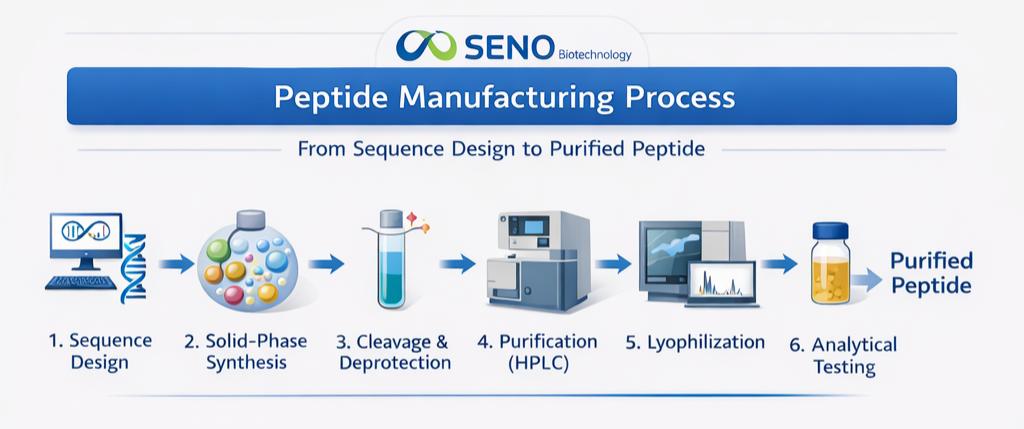
The development of research peptides typically follows a structured scientific workflow involving synthesis, purification, analytical verification, and quality control.
Standard Peptide Research Process
- Peptide sequence design
- Solid-phase peptide synthesis (SPPS)
- Cleavage and deprotection
- Chromatographic purification
- Analytical characterization
- Quality control verification
- Batch documentation and release
Each stage contributes to the structural accuracy, purity, and reproducibility of peptide products used in laboratory experiments.
Peptide Synthesis Technologies
Solid-Phase Peptide Synthesis (SPPS)
Solid-phase peptide synthesis (SPPS) is the most widely used technology for producing synthetic peptides. Originally developed by Robert Bruce Merrifield, this method allows sequential assembly of amino acids on a solid resin support.
Key characteristics of SPPS include:
• stepwise amino acid coupling
• automated synthesis capability
• compatibility with Fmoc-based chemistry
• efficient production of defined peptide sequences
The Fmoc (9-fluorenylmethoxycarbonyl) protection strategy is widely used in modern peptide synthesis due to its mild deprotection conditions and compatibility with automated synthesizers.
SPPS enables researchers to generate peptides with precise amino acid sequences, enabling experimental studies of protein fragments, signaling molecules, and synthetic peptide analogs.
Peptide Purification Technologies
Chemical synthesis often produces a mixture of desired peptide products along with truncated sequences and side products. Purification is therefore essential to obtain high-quality peptide materials.
Reverse-Phase High Performance Liquid Chromatography
The most common purification technique is High‑Performance Liquid Chromatography (HPLC), particularly reverse-phase HPLC.
In this technique, peptides are separated according to their hydrophobic interactions with the stationary phase of the chromatography column.
Common purification systems include:
• C18 reverse-phase columns
• gradient elution using water and acetonitrile
• UV detection systems for peptide monitoring
Reverse-phase HPLC allows separation of peptides with high resolution and is also widely used to measure peptide purity.
Peptide Characterization Technologies
Accurate peptide characterization requires multiple analytical techniques to confirm molecular identity, purity, and structural integrity.
Mass Spectrometry Analysis
One of the most widely used analytical tools is Mass Spectrometry, which determines the molecular mass of peptides with high precision.
Common analytical systems include:
• Electrospray Ionization Mass Spectrometry (ESI-MS)
• MALDI-TOF mass spectrometry
• LC-MS integrated systems
Mass spectrometry allows detection of sequence variants, incomplete synthesis products, and structural modifications.
Chromatographic Purity Analysis
Analytical HPLC is used to determine peptide purity by comparing the peak area of the target peptide with the total chromatographic signal.
Typical research peptide purity ranges include:
| Purity Level | Application |
|---|---|
| ≥95% | Standard biochemical research |
| ≥98% | High-precision molecular studies |
| ≥99% | Advanced analytical research |
Additional chromatographic techniques may also be used for structural analysis:
• size exclusion chromatography (SEC)
• ion exchange chromatography (IEX)
• hydrophilic interaction chromatography (HILIC)
These methods help detect peptide aggregation, charge variants, and hydrophilic impurities.
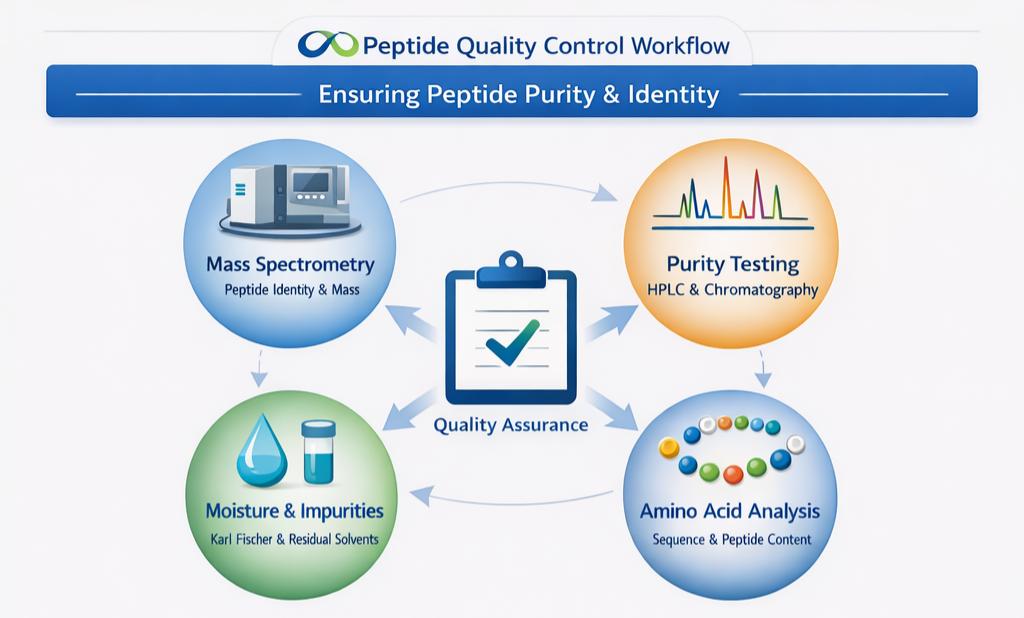
Peptide Quality Control Systems
Reliable research peptides require a structured analytical and documentation system that verifies product identity and purity.
Advances in Peptide Analytical Research
Rapid improvements in analytical chemistry and computational biology are expanding the capabilities of peptide science.
Recent research developments include:
• high-resolution LC-MS/MS peptide identification
• automated peptide sequencing algorithms
• machine-learning-based proteomics analysis
• structural modeling of peptide-receptor interactions
These technologies are enabling scientists to analyze complex peptide structures and interactions with increasing accuracy.
Scientific Literature
The development of modern peptide chemistry and analysis is supported by decades of scientific research.
Key foundational studies include:
Robert Bruce Merrifield (1963)
Solid-Phase Peptide Synthesis. Journal of the American Chemical Society.
Fields & Noble (1990)
Fmoc Solid Phase Peptide Synthesis.
**Ruedi Aebersold & Matthias Mann (2003)
Mass Spectrometry-Based Proteomics. Nature.
These studies established many of the technologies that continue to influence peptide synthesis and analytical workflows today.
Research Applications
Research peptides are widely used in laboratory environments including:
• molecular biology research
• protein interaction studies
• biochemical assay development
• structural biology experiments
• biotechnology product development
These materials support scientific investigation into biomolecular mechanisms and experimental biotechnology innovation.
Research Use Notice
All materials described on this website are intended for laboratory research use only.
They are not intended for medical use, therapeutic applications, or diagnostic purposes.