
Quick Answer
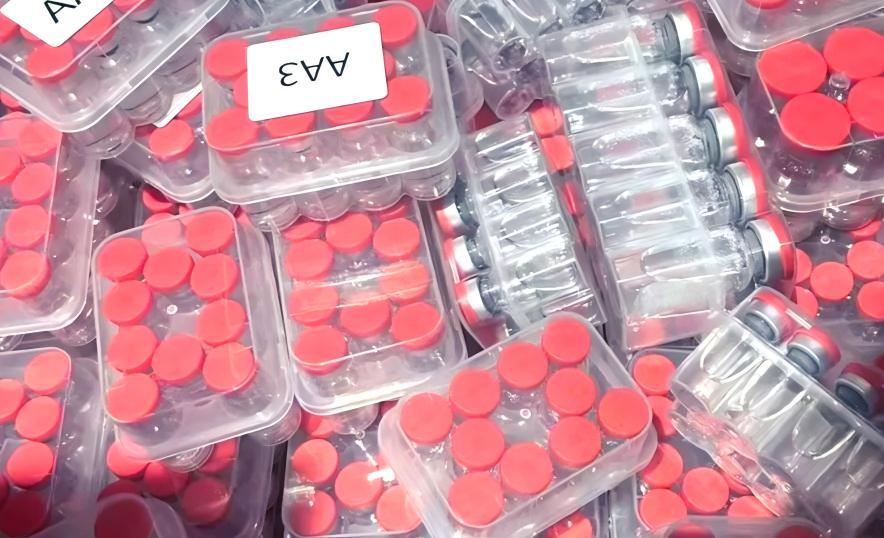
Peptide reconstitution refers to the controlled process of converting lyophilized (freeze-dried) peptide material back into a liquid solution for experimental use in laboratory investigations. It is a critical step in ensuring that peptides regain a uniform, measurable state suitable for analytical characterization, receptor-binding studies, and cell signaling research.
From a research perspective, the reconstitution process is not simply “dissolving a powder,” but a sensitivity-driven preparation step where solvent selection, concentration accuracy, and handling conditions can significantly influence molecular integrity and downstream reproducibility.
Key considerations include peptide stability, aggregation risk, and solvent compatibility, all of which directly affect experimental reliability.
Key takeaway: In peptide science, reconstitution is a foundational preparation step that determines whether a peptide sample behaves consistently in analytical and experimental systems.
2. What Is Peptide Reconstitution?
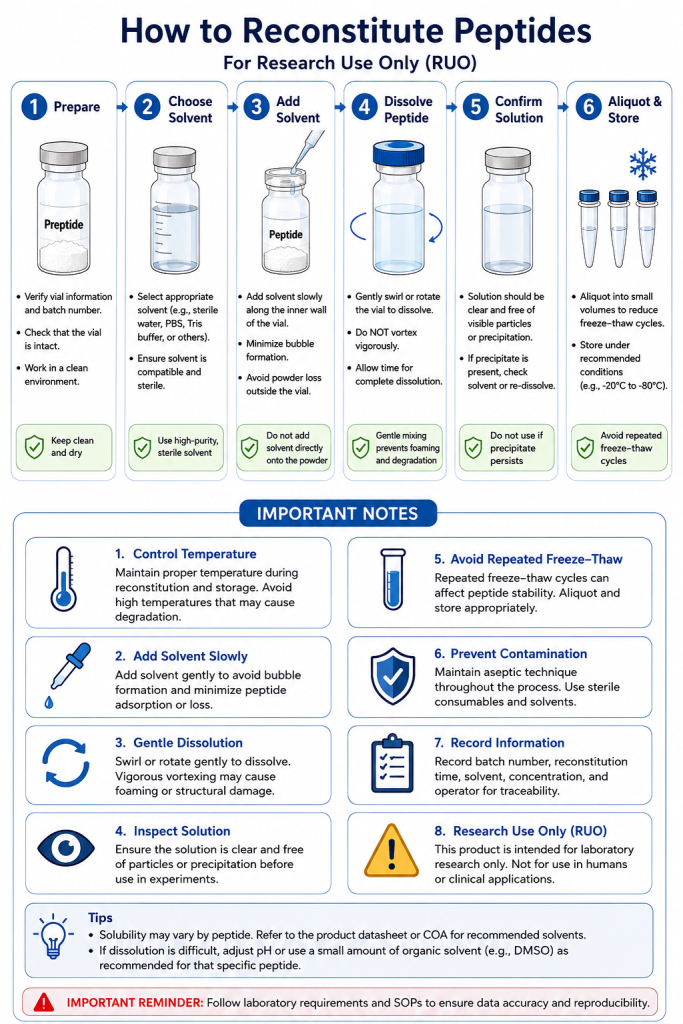
Peptide reconstitution is the process of solubilizing lyophilized peptide material into a defined liquid medium under controlled laboratory conditions.
Most research peptides are supplied as:
- Lyophilized powders (freeze-dried solids)
- Stored in low-moisture, low-temperature conditions
Structurally, peptides are short amino acid chains that can be highly sensitive to:
- pH changes
- solvent polarity
- ionic strength
- agitation stress
Reconstitution restores the peptide into a homogeneous solution state, allowing it to be used in controlled experimental workflows such as binding assays or analytical profiling.
3. Why Researchers Study It
Although reconstitution is a preparation step, it is scientifically important because it directly influences:
- Receptor-binding studies
- Ensures ligand availability in solution form
- Cell culture experiments
- Requires consistent peptide dispersion
- Protein interaction studies
- Depends on structural integrity in solution
- Analytical assay development
- Requires reproducible concentration and stability conditions
Researchers study peptide behavior during reconstitution to understand:
- solubility limits
- aggregation tendencies
- structural stability in solution
These factors are essential for experimental reproducibility and data comparability across laboratories.
4. Molecular Characteristics and Mechanism in Solution
Once reconstituted, peptides transition from a solid-state crystalline or amorphous form into a dynamic aqueous or buffered solution system.
Key molecular behaviors include:
- Hydration of peptide backbone
- Water molecules interact with amide bonds
- Conformational flexibility
- Peptides may adopt multiple transient structures
- Aggregation potential
- Hydrophobic sequences may self-associate in solution
- Charge-dependent solubility
- Influenced by pH and ionic environment
At the molecular level, solution behavior is not static—peptides continuously fluctuate between conformations, which can affect binding affinity in receptor interaction studies and analytical signal consistency.
5. Research Challenges and Experimental Considerations
Peptide reconstitution introduces several technical challenges that can affect experimental outcomes:
- Solubility limitations
- Some sequences dissolve slowly or incompletely depending on solvent conditions
- Degradation risk
- Hydrolysis or oxidation may occur if exposed to unsuitable environments
- Adsorption effects
- Peptides may bind to plastic or glass surfaces, altering effective concentration
- pH sensitivity
- Small pH shifts can significantly affect structural stability
- Handling variability
- Agitation methods may introduce foam formation or aggregation
Laboratory scenario example:
Two researchers prepare identical peptide samples using the same nominal solvent. However, one sample is vortexed aggressively while the other is gently mixed. In subsequent receptor-binding assays, the first sample shows reduced signal consistency due to aggregation-induced variability, despite identical starting material.
6. Quality Verification Checklist
- Identity Verification
- LC-MS molecular mass confirmation
- Purity Verification
- HPLC chromatographic profile analysis
- Impurity peak identification and quantification
- Solution Stability Assessment
- Aggregation and degradation monitoring
- Documentation Review
- Certificate of Analysis (COA) validation
- Batch traceability confirmation
- Manufacturing Controls
- Peptide synthesis consistency
- Contamination prevention processes
7. Common Misunderstandings
- “Dissolution equals uniformity” misconception
- A visually clear solution may still contain micro-aggregates affecting experimental outcomes
- COA interpretation limits
- A COA confirms identity and selected metrics but does not capture reconstitution behavior in all solvent systems
- Storage assumptions
- Stability in powder form does not guarantee identical stability once in solution
- Reproducibility myths
- Identical peptide names do not guarantee identical solution behavior across labs due to handling and solvent differences
A COA is similar to a passport—it verifies identity, but it does not describe how the molecule behaves in every experimental environment.
8. Research Applications Overview
| Research Area | Why Studied |
|---|---|
| Cell Biology | Observing peptide-induced cellular responses in controlled environments |
| Receptor Biology | Studying ligand-receptor interaction dynamics in solution |
| Molecular Signaling | Mapping activation pathways in aqueous systems |
| Assay Development | Establishing reproducible peptide-based experimental assays |
9. Frequently Asked Questions
1. Why is reconstitution important in peptide research?
Reconstitution ensures peptides are in a usable solution state for experimental analysis. It matters because peptide behavior in solution directly affects assay consistency and reproducibility in laboratory investigations.
2. What does “complete dissolution” mean?
It refers to the absence of visible particulate matter. However, microscopic aggregation may still exist, which is why analytical verification is important for research accuracy.
3. Why do peptides behave differently after reconstitution?
Solution conditions such as pH, ionic strength, and solvent composition can alter peptide conformation and stability, influencing experimental outcomes.
4. What is the role of solvent choice?
Solvent polarity and composition determine solubility efficiency and structural stability. This is critical for maintaining reproducibility in receptor-binding studies.
5. Can peptides degrade after reconstitution?
Yes, peptides may undergo hydrolysis or oxidation depending on environmental conditions. This is why stability monitoring is important in experimental workflows.
6. Why do different labs get different results?
Variations in handling, solvent systems, and storage conditions can lead to differences in peptide behavior, even when using identical material.
7. Is aggregation common in peptide solutions?
Certain sequences are prone to self-association. Aggregation can affect binding behavior and assay signal consistency.
8. What does COA confirm in this context?
It confirms identity, purity, and analytical validation of the dry peptide, but not its behavior after dissolution.
9. Why is LC-MS important?
LC-MS verifies molecular mass, ensuring the correct peptide structure is present before experimental use.
10. How should variability be controlled?
Standardized handling protocols, consistent solvent systems, and verified analytical characterization help reduce experimental variability.
10. Final Summary
- Peptide reconstitution is a critical preparation step in research workflows
- Solution behavior is influenced by solvent, pH, and handling conditions
- Analytical tools like HPLC and LC-MS are essential for verification
- Peptide stability and aggregation can affect experimental reproducibility
- COA and labeling data must be interpreted alongside real solution behavior
If this article does not fully answer your technical questions, contact our team for detailed product specifications, analytical testing information, batch-specific COA documentation, purity verification data, and custom research material solutions.